In this guide
My garage started with a gravel floor, but most garages get a concrete slab — either poured with the footing (a monolithic slab) or poured later inside a stem wall. Either way, the parts are the same, and most slab problems come from shortcuts in the layers you can’t see.
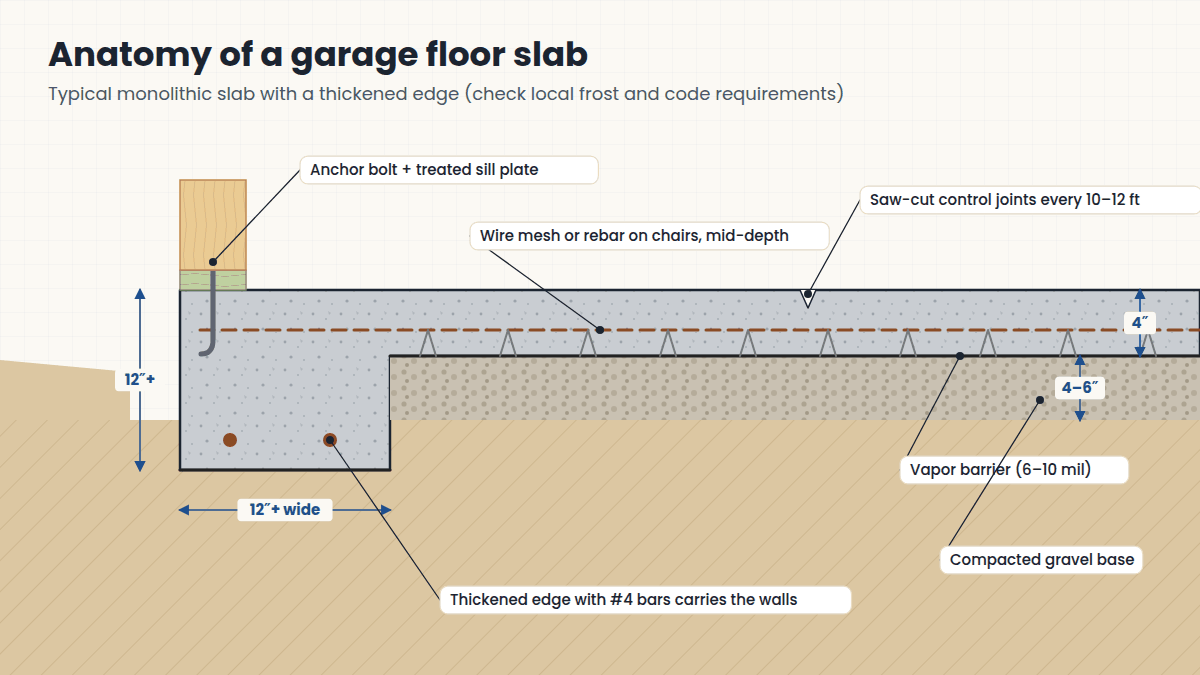
The layers of a garage slab
- Compacted subgrade. Remove topsoil and organic material, then compact the soil. Soft spots become cracks later.
- Gravel base. Typically 4 inches or more of compacted crushed stone for drainage and uniform support.
- Vapor barrier. A 6- to 10-mil polyethylene sheet keeps ground moisture from wicking up through the slab.
- Reinforcement. Welded wire mesh or rebar, held up on chairs so it ends up in the middle of the slab — not lying on the bottom.
- Concrete. Usually 4 inches thick for cars; thicker if you’ll park heavy trucks or use a car lift.
- Thickened edge. Under the walls in a monolithic slab, commonly at least 12 inches wide and deep, with rebar.
Slope and drainage
Many builders slope the garage floor slightly toward the door — around ⅛ inch per foot — so melting snow runs out instead of pooling. Decide this before forming, because it’s set by your screed rails.
Ordering the right concrete
Ask your supplier for a mix suitable for exterior slabs in your climate. In freeze-thaw areas that usually means higher-strength, air-entrained concrete, which resists damage from de-icing salts dripping off cars. Order about 5–10% extra — running short mid-pour is a disaster.
Control joints
Concrete shrinks as it cures and it will crack. Control joints tell it where to crack in a straight, hidden line. A common rule is to space joints no more than 2 to 3 times the slab thickness in feet (8 to 12 feet apart for a 4-inch slab), cut about a quarter of the slab’s depth, and make the panels as close to square as possible.
Hire the finishers
Placing and finishing a garage slab is hard, fast work, and the concrete won’t wait for you. Even hardcore DIYers often hire a finishing crew for pour day and do all the prep themselves — it’s the same logic I used for roofing.
Curing
Keep the slab moist for about a week by misting, covering with plastic, or using a curing compound. Protect it from freezing and from hot, windy days. Don’t park on it until it has gained enough strength, often a week or more.
Wet concrete burns
Fresh concrete is caustic. Wear waterproof boots, gloves, long sleeves and eye protection, and rinse off any concrete that gets on your skin right away.
Key Takeaways
- The base, vapor barrier and reinforcement matter as much as the concrete.
- Four inches is typical for cars; thicken for heavy vehicles or lifts.
- Plan control joints and curing before pour day.

Leave a Reply