In this guide
I chuckle at people who say they built their own home, when all they really did was walk into a neighborhood builder’s office and fill out a specification form. But that is what some people consider “building it themselves.” After all, there wasn’t a structure there until they got involved, and now there is. So okay.
If that’s all you want to do when you build your garage, this site can still help you through the planning and building process — by helping you make good decisions and verify that the work is being done properly.
The three roles on any construction project
There are a few basic levels of involvement in construction, and you can choose to be any or all of them.
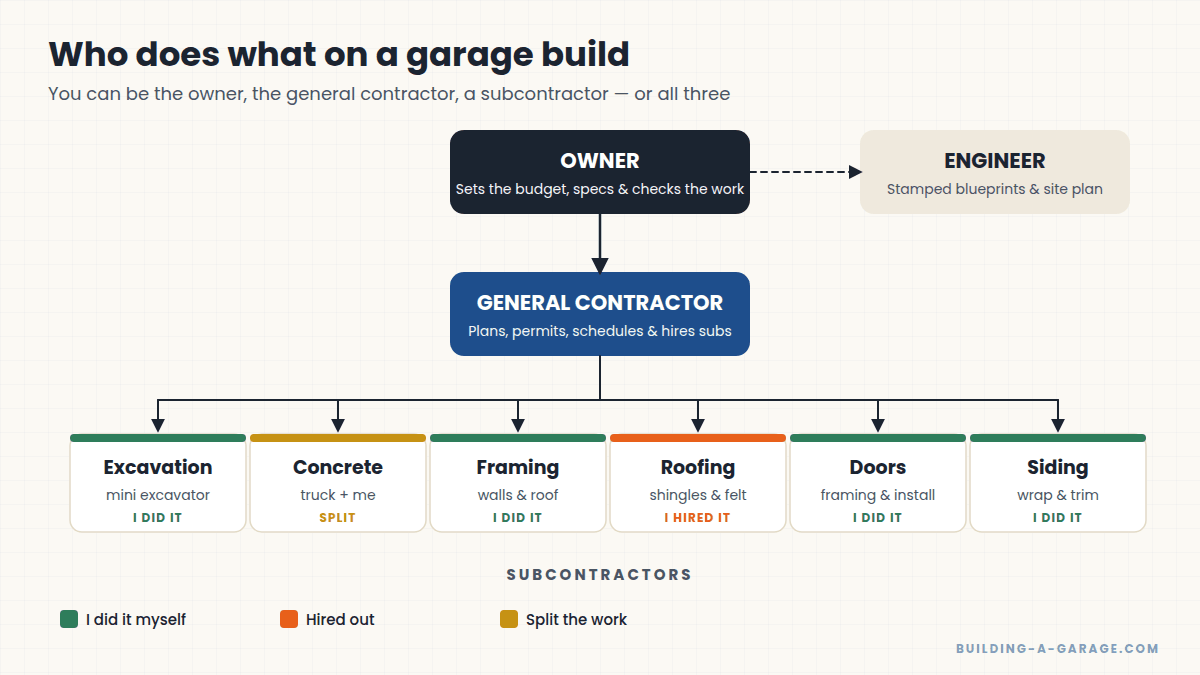
Owner
The owner works out the specifications with a builder and checks on the work to make sure it’s being done properly and on schedule. The owner might also handle permits and blueprints if the builder doesn’t.
General contractor
The general contractor (GC) is the main builder the owner works with. Many of you will choose to be the general contractor as well as the owner. In that case you’re responsible for hiring subcontractors to complete sections of the project — excavation, foundation, framing, roofing, doors and so on. You’re also responsible for getting the blueprints and permit, and for making sure every inspection is performed.
Subcontractors
Subs handle particular pieces of the project. You might have an excavating company prepare the site, a concrete company build the foundation, and other subs handle the framing and finishing. If you’re competent in a particular area, you can do some of that work yourself. Plenty of people, for example, like to do their own siding and trim.
Or you can do what I did: everything
Well — not quite everything.
- I had a roofing subcontractor install the shingles, ice-and-water shield and tar paper. It would have taken me weeks to do what their crew did in a day.
- I had an engineer create the blueprints. They served as my instructions, and they were required for the permit.
- I had a concrete company deliver the concrete for the foundation using a mixer truck with a conveyor belt, and the driver helped get the concrete where it needed to go.
Everything else I did myself or with my wife’s help.
Hire the “one-day” jobs
Look for jobs a skilled crew finishes in a day that would take you weeks: roofing, concrete placement and finishing, and sometimes excavation. Paying for those often costs less than it saves in rentals, mistakes and time.
Being your own general contractor: what it involves
If you act as your own GC, your to-do list includes:
- Getting plans drawn (or using your county’s standard plan) and applying for the permit.
- Collecting at least three written quotes for any work you hire out — and reading the exclusions.
- Scheduling subs in the right order so nobody waits on anybody else.
- Ordering materials so they arrive when needed (and stay dry).
- Calling for each inspection before the work gets covered up.
- Keeping every receipt, lien waiver and inspection signature.
Check the rules for owner-builders
Most areas let homeowners pull permits and build on their own property, but some require an owner-builder declaration, limit which trades you can do yourself (electrical is the usual one), or restrict selling the property soon afterward. Ask your building department before you start.
Checking a contractor’s work
Even if you hire out most of the job, you can protect yourself by knowing what to look for at each phase: square and level foundations, anchor bolt spacing, stud spacing, nailing patterns, headers over openings, and proper flashing. Each guide on this site explains what “right” looks like.
Key Takeaways
- You can be the owner, the general contractor, a subcontractor — or any mix.
- Hire the jobs a crew can finish in a day; do the rest yourself if you have the time.
- As your own GC you own the schedule, the permit and the inspections.
Leave a Reply