In this guide
The next thing I needed to figure out was how the garage was going to be built. Most of my quotes were for one method, but that didn’t necessarily make it the right one for me.
Post-and-beam (pole building) construction
I bought a book on post-and-beam construction — formerly called pole building — since that’s what many of the quotes were for. I figured it must be a cost-effective, efficient way to build if contractors were quoting it.
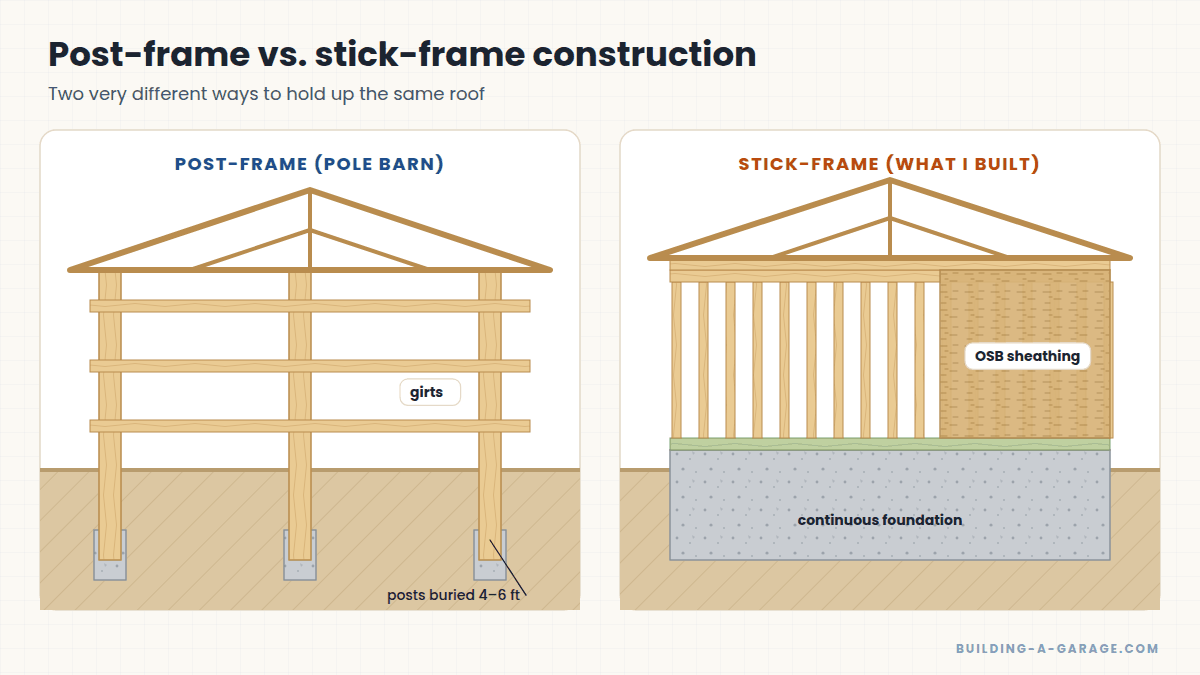
What I learned is that in post-frame construction, the main support of the building is in the posts, which are buried deep in the ground in holes filled with concrete. Between the posts are upper and lower girts (horizontal boards) that stabilize them. The upper girders carry the roof trusses or rafters. Early pole buildings were made with used telephone poles, but round poles made it hard to attach the girders, and nobody could accurately estimate the strength of an old telephone pole.
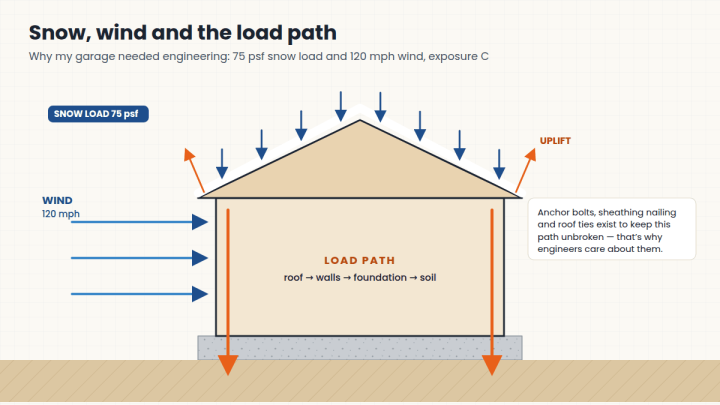
I also learned that post-and-beam construction wasn’t common in my area. To build one strong enough for my snow and wind loads, the heavy timbers would cost a fortune and the posts would have to be buried ridiculously deep.
Stick-frame construction
The other option was traditional frame construction — the way most houses are built today. It takes a lot of lumber, but most of it is inexpensive, and framing is easy for a do-it-yourselfer to learn. The structure’s support is spread across many framing members, which makes it fairly forgiving.
A wall frame of 2×4 or 2×6 lumber is built, then covered with oriented strand board (OSB) sheathing. The studs provide up-and-down strength, while the OSB provides the lateral (racking) strength that keeps the studs upright. The roof is built with pre-made trusses or rafters, covered with more OSB, then roofing. The wall OSB is covered with whatever siding you like.
I learned that stick framing is easier for amateurs, even though it requires a real foundation — which may or may not have to be handled by professionals.
Side-by-side comparison
| Feature | Post-frame (pole barn) | Stick frame |
|---|---|---|
| Foundation | Posts in holes; often no continuous foundation | Continuous foundation or slab |
| Materials | Fewer, larger members | Many small, cheap members |
| Precision | Critical — load concentrated in a few posts | Forgiving — load spread out |
| Speed | Fast shell for large spans | Slower, but easy to learn |
| Interior finish | Harder to insulate and finish | Easy to insulate, wire and drywall |
| Best for | Farm buildings, big spans, mild loads | Garages, workshops, heavy snow areas |
Why I chose stick framing
With 75-psf snow loads and 120-mph wind, a post-frame garage would have needed expensive heavy timbers and very deep posts. Stick framing spread the load over dozens of studs, let me do every step myself, and satisfied the engineer.
What about steel buildings and kits?
Metal buildings and garage kits are another option. They go up quickly, but you still need a foundation, permits and often an engineered anchoring system. Compare the full delivered price — plus concrete, doors and finishing — against a stick-built materials list.
Key Takeaways
- Post-frame concentrates loads in a few posts; stick framing spreads them out.
- Heavy snow and wind loads can make post-frame far more expensive.
- Stick framing is the easiest method for a first-time builder to learn.
Leave a Reply